
Cuscuta fasciculata
CUSCUTA FASCICULATA YUNCKER IS NOW A SYNONYM OF CUSCUTA UMBELLATA KUNTH
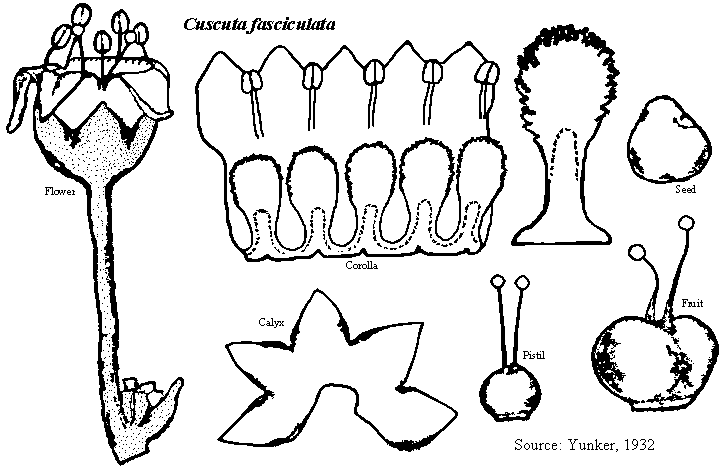
Parasitic annual, which resembles a pile of slender orange-yellow string entangled among weeds and low vegetation; leaves absent; flowers about 2.5 mm long on pedicels often several times as long as the flowers, all arranged in fairly dense clusters; calyx base round, the 5 lobes broadly triangular; corolla tube almost enclosed by the calyx, the 5 lobes oval-ovate, obtuse, not overlapping at base, usually reflexed; stamens about as long as corolla, slightly exserted; scales within base of corolla 5, barely reaching the base of stamens, each scale broadly spatulate, narrowed at the base, fringed around the broader tip; ovary globose, slightly pointed at the style bases; capsule depressed-globose, circumscissile, containing 3-4 subglobose seeds about 1 mm long. Flowers late July to early September.
All species of Cuscuta, resembling piles of orange-yellow string, are superficially similar. Yuncker (1932) compares C. fasciculata directly to C. umbellata, a species common throughout New Mexico. Cuscuta umbellata has a broadly conical calyx base, acute corolla lobes, longer scales and shorter filaments (he gives no dimensions for these in either species). In his illustration he shows the scales reaching at least to the filaments of the stamens, whereas in C. fasciculata there is a definite gap between the scale tip and the filament base. In his key he makes a distinction on flower size, C. umbellata among species with flowers about 3 mm long, C. fasciculata with species that have flowers mostly about 2 mm long.
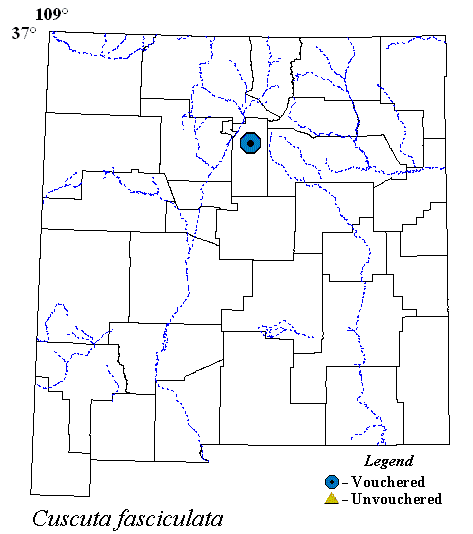
New Mexico, Santa Fe County.
Unknown; presumably in disturbed areas on other weeds, at about 2,130 m (7,000 ft).
Costea and Stefanovic (2010) state, "Cuscuta fasciculata, known from a single specimen (Yuncker 1932), is morphologically identical to typical C. umbellata, and the former name is therefore considered a heterotypic synonym." The NMRPTC accepts this taxonomic treatment.
None
*Yuncker, T.G. 1932. The genus Cuscuta. Memoirs of the Torrey Botanical Club 18:1-331.
Costea, M. and S. Stefanovic. 2010. Evolutionary history and taxonomy of the Cuscuta umbellata complex (Convolvulaceae): Evidence of extensive hybridization from discordant nuclear and plastid phylogenies. Taxon 59(6):1783-1800.
For distribution maps and more information, visit Natural Heritage New Mexico