
Synthyris oblongifolia (Egg-Leaf Coral-Drops)
BESSEYA OBLONGIFOLIA PENNELL
| USFWS | State of NM | USFS | BLM | Navajo Nation | State Rank | Global Rank | NMRPTC Status |
|---|---|---|---|---|---|---|---|
| SEN, SCC | S1 | G1 | R |
| Overall Conservation Status | Documented Threats | Actions Needed |
|---|---|---|
| WEAKLY CONSERVED | Recreation |
Status surveys on abundance, distribution and threats. Seed banking |
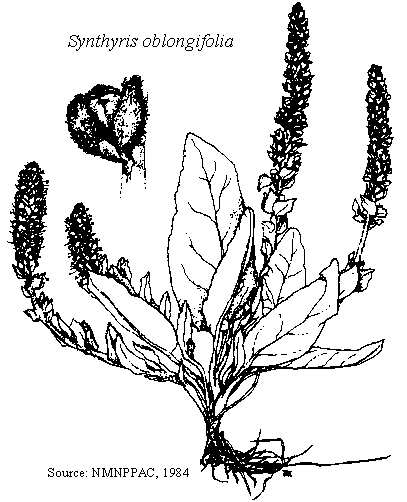
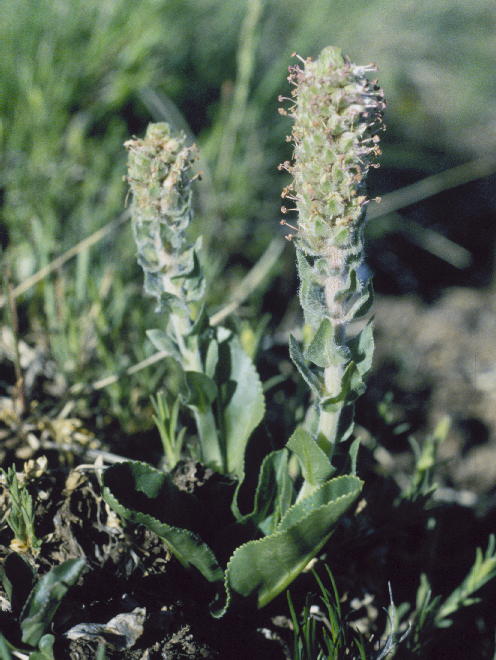
Perennial herb; stems to 30 cm high, densely hairy, usually with 12-16 small bract-like leaves below the flower cluster; basal leaves oblong, mostly 7-11 cm long, 25-30 mm wide, rounded at the tip, with rounded teeth on the margins; petioles about 5-10 cm long, with longitudinal rows of soft hairs; flower clusters narrow, 5-10 cm long; flowers white, 5-6 mm long; capsules hairy, 4-5 mm long. Flowers June to September.
Synthyris plantaginea has hairless capsules and sepals, and leaves that are hairy, at least beneath.
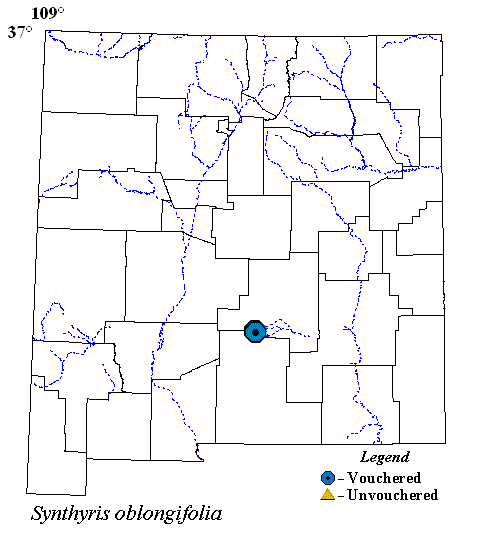
New Mexico, Lincoln and Otero counties, Sacramento Mountains.
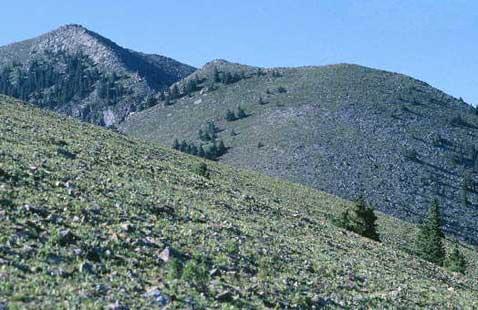
Alpine meadows; 3,350-3,600 m (11,000-12,000 ft).
Restricted to a few sites in the Sierra Blancas. A specimen from Taos County tentatively identified as Synthyris oblongifolia has been determined not to be that species.
Sierra Blanca kittentails survived the 2012 Little Bear Fire by nature of its habitat. It is potentially threatened by trampling in the vicinity of the Lookout and road maintenance acitivities.
*New Mexico Native Plants Protection Advisory Committee. 1984. A handbook of rare and endemic plants of New Mexico. University of New Mexico Press, Albuquerque.
Pennell, F.W. 1933. A revision of Synthyris and Besseya. Proceedings of the Academy of Sciences of Philadelphia 85:83-93.
Hufford, L. and M. McMahon. 2004. Morphological evolution and systematics of Synthyris and Besseya (Veronicaceae): A phylogenetic analysis. Systematic Botany 29(3):716-736.
For distribution maps and more information, visit Natural Heritage New Mexico