

Agalinis calycina (Leoncita False Foxglove)
GERARDIA CALYCINA (PENNELL) PENNELL
| USFWS | State of NM | USFS | BLM | Navajo Nation | State Rank | Global Rank | NMRPTC Status |
|---|---|---|---|---|---|---|---|
| E | S1 | G1 | R |
| Overall Conservation Status | Documented Threats | Actions Needed |
|---|---|---|
| WEAKLY CONSERVED | Water management/use |
Status surveys on abundance, distribution and threats, seed banking |

Agalinis calycina was added to the NMRPL in 2008 and assigned a Class 1 designation in 2025 due to its limited distribution and ongoing, pervasive threats to its sensitive ciénega habitats.
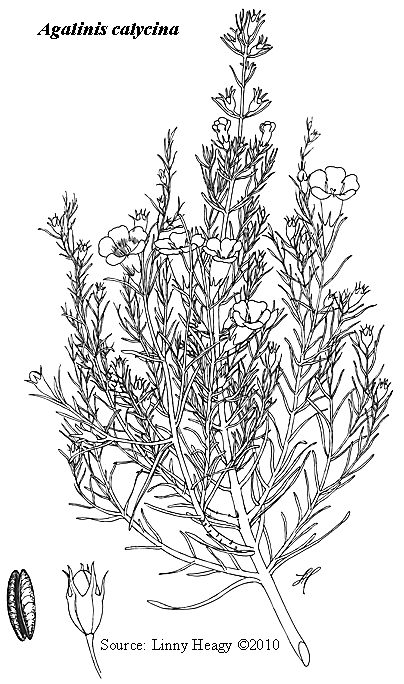
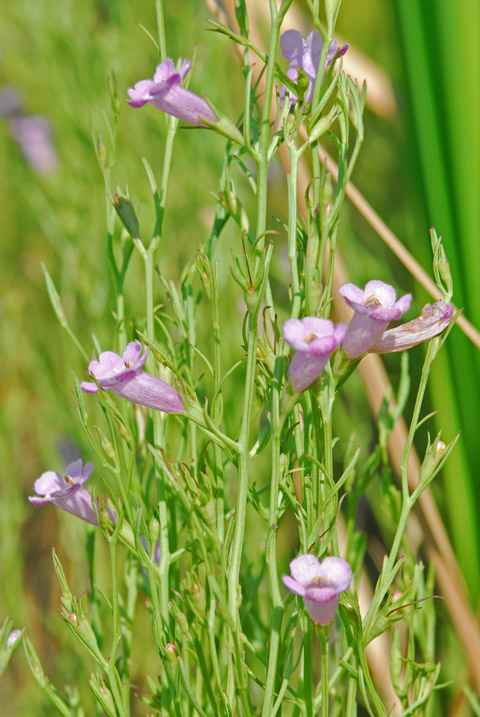
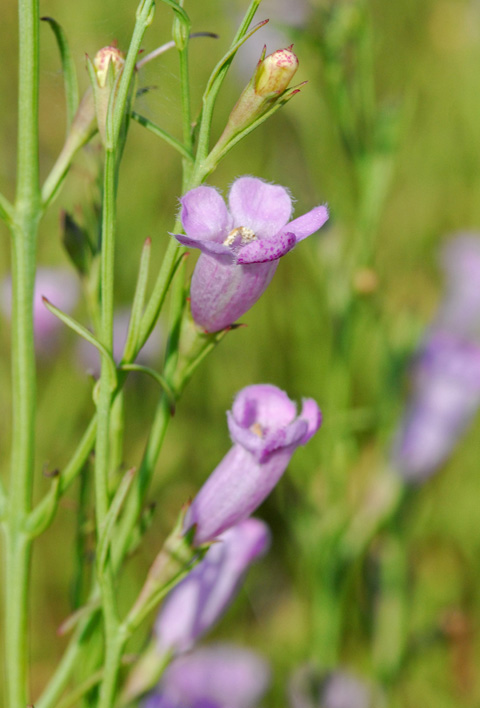
Annual, hemiparasitic, somewhat succulent, glabrous (except floral parts), to about 50 cm tall, with numerous divergent, ascending branches, green or purplish, drying blackish; leaves mostly opposite (especially below), linear, entire, stem leaves 2-4 cm long, 1-1.5 mm wide; inflorescences racemose, bracteate, 4 to 12-flowered, pedicels ascending, glabrous, 5-7 mm long; calyx tube 5-6 mm long, campanulate, calyx lobes narrowly triangular to nearly linear, 5-15 mm long, finely puberulent within; corolla pink, 20-25 mm long, tube 17-21 mm long, lobes 3-5 mm long, rounded-truncate, ciliate, pubescent outside; stamens 4, in two pairs of unequal length, anthers and usually filaments lanate; style about 15 mm long, pubescent; fruit a capsule about as long or slightly longer than the calyx lobes, ovate, apex rounded and mucronate; seeds numerous.
One other species of Agalinis may occur in New Mexico (probably in the northeastern quadrant of the state), but it does not grow in ciénegas. Otherwise, Leoncita false foxglove is unlikely to be confused with any other plant.
New Mexico, Chaves County, Bitter Lake National Wildlife Refuge; Texas, Pecos County, Diamond Y Spring; Mexico, Coahuila, Muzquiz Spring near Parras.
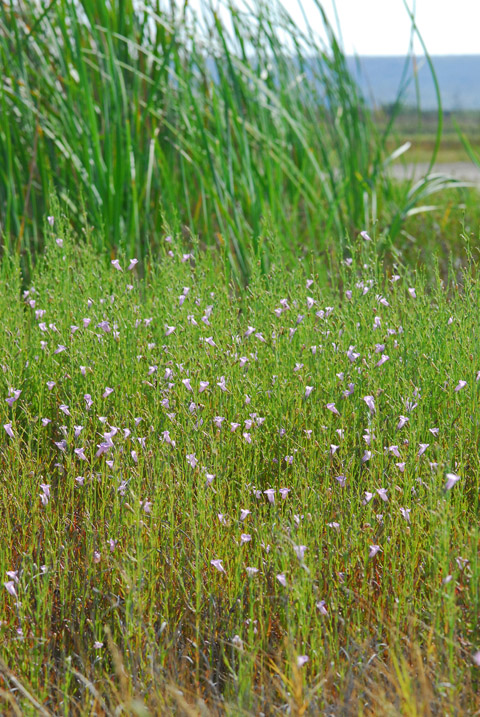
Perennially moist alkaline/saline/calcareous soils in ciénega (wet meadow) habitat around aridland springs and seeps.
Agalinis calycina was first collected by John M. Bigelow, a physician from Ohio, in 1852 while on the Mexican Boundary survey in West Texas. "Leoncita" refers to a Leon or Leone Spring in West Texas where the plant was first found. It is presently known from only three to four widely separated locations. The Bitter Lake NWR, New Mexico, and Diamond Y Spring, Texas, populations are known to be extant. The collections reported for Coahuila are historically obscure or misidentified and the species cannot be confirmed as ever existing there. Two other rare plants, Pecos sunflower (Helianthus paradoxus) and Wright’s marsh thistle (Cirsium wrightii), often grow with Leoncita false foxglove in New Mexico.
There is some debate around whether specimens from Coahuila, Mexico, annotated as A. calycina (Marsh 920 and 2 Aug 1848, Dr. Edwards s.n.), correspond to the same species that occurs in NM and TX. Recent iNaturalist observations from areas near these historical specimens appear to match best with A. heterophylla or possibly an undescribed Agalinis species but differ from A. calycina in having less succulent foliage, shorter pedicels, and darker pink flowers.
More research is needed to determine Leoncita False Foxglove’s host plant and if it specializes on a single host species or can parasitize multiple different plants. Sivinski observed A. calycina growing in pure stands of Distichlis spicata (saltgrass) at Bitter Lake NWR, suggesting that saltgrass represents at least one of its hosts (Sivinski 2011).
Since the species is restricted to ciénegas, which are rare and declining in New Mexico and West Texas, it is particularly vulnerable to drought and aquifer depletion. Other potential and documented threats include competition from invasive plants (e.g., Phragmites, Tamarix), damage to habitat and plants by feral pigs (Texas population), extreme flooding events, oil and gas development, watershed pollution, and conflicting resource management priorities. At Bitter Lake NWR, biologists are managing units to support long-term viability of A. calycina. Seeds for ex situ conservation have been collected and deposited at the ABQ BioPark and Bitter Lake NWR staff have successfully introduced plants into a new area of the Refuge by manually distributing seeds.
Cantu de Leija, A., King, S. L., and T. S. Hawkins. 2022. Seed germination responses to salinity for three rare wetland plants of spring-fed arid systems. Journal of Arid Environments, 199. https://doi.org/10.1016/j.jaridenv.2021.104705
Cantu de Leija, A. and S. L. King. Relationships among rare plant communities and abiotic conditions in managed spring-fed arid wetlands. Restoration Ecology, 32. https://doi.org/10.1111/rec.14011
Johnson, W. P., and J. S. Beauchamp. 2022. Distribution of Helianthus paradoxus (Asteraceae) and Agalinis calycina (Orobanchaceae) on Bitter Lake National Wildlife Refuge, New Mexico, U.S.A. Journal of the Botanical Research Institute of Texas, 16(2), 573–584.
Pennell, F.W. 1928. Agalinis and allies in North America: I. Proceedings of the Academy of Natural Sciences of Philadelphia, 80: 339–449.
Pennell, F.W. 1929. Agalinis and allies in North America: II. Proceedings of the Academy of Natural Sciences of Philadelphia, 81: 111–249.
Poole, J.M., W.R. Carr, D.M. Price and J.R. Singhurst. 2007. Rare plants of Texas: A field guide. W.L. Moody Jr. Natural History Series, number 37. Texas A&M University Press, College Station. 656 pp.
Purdy, M. and E. Rowe. 2025. Agalinis calycina (Leoncita false foxglove) 2024 surveys at Bitter Lake National Wildlife Refuge. Unpublished report prepared by the NM Energy, Minerals and Natural Resources Department, Forestry Division for the US Fish & Wildlife Service, Region 2.
Williams, J.E. and J. Henrickson. 1997. In: Henrickson, J. and M.C. Johnston, eds. A flora of the Chihuahuan Desert region, ed. 1.2, 2 vols. Published by J. Henrickson, Los Angeles (trial version for correction).
For distribution maps and more information, visit Natural Heritage New Mexico