Description
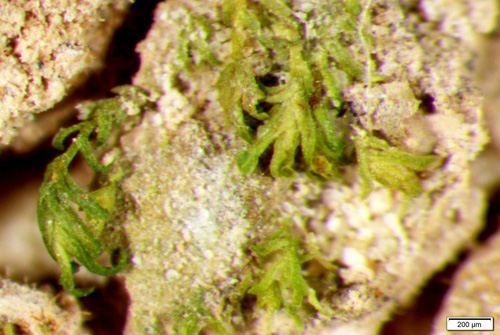
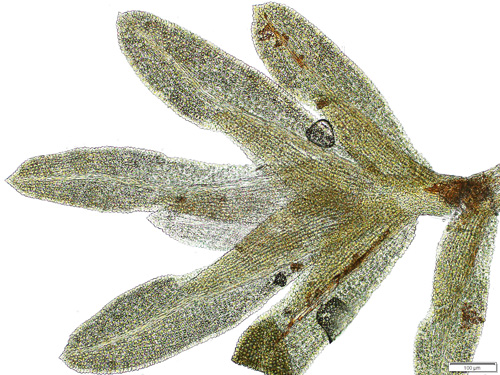
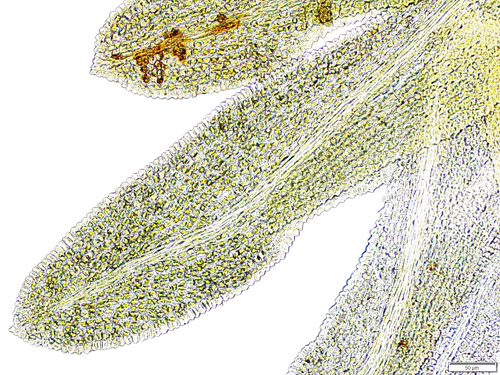
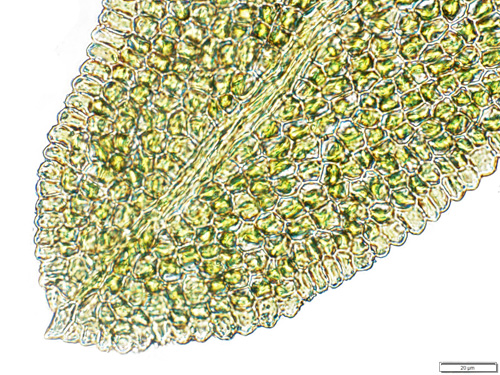
Acrocarpic moss to 3 mm tall and 2 mm wide, the stems not or sparingly branched; central strand absent; leaves distichous, equitant, consisting of 2 laminae that clasp the stem, arranged on edge to the stem and split at the base, to 1.5 mm long and 0.25 mm wide, as many as 8 pairs on the stem, not crisped upon drying; vaginant laminae 1/2 to 2/3 the leaf length; margins crenulate, elimbate; costae ending 3-5 cells before leaf apex; cells of the laminae 1-stratose, mammillose, irregularly quadrate to hexagonal, oblate on the margins, 8-10 µm long/wide; sporophytes 1 per perichaetium; setae 1.4-1.8 mm long; capsules erect, symmetrical, to 0.5 mm long; peristome single, the teeth 16, undivided, papillose; operculum to 0.3 mm wide; calyptra cucullate, smooth, about 0.3 mm wide; spores 8-11 µm.
Similar Species
Fissidens sublimbatus Grout is rather common on nearby bluffs, both gypsiferous and not: its leaves usually have an easily noticeable limbidium on the margins (absent in littlei), and its cells lack a mammilose, nipple-like projection (present in littlei).
Distribution
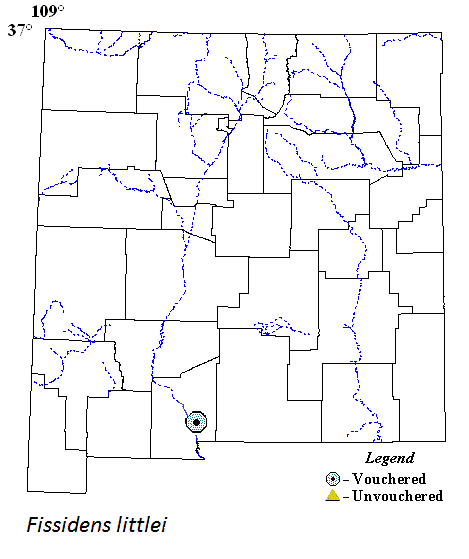
New Mexico: central Dona Ana County.
Habitat
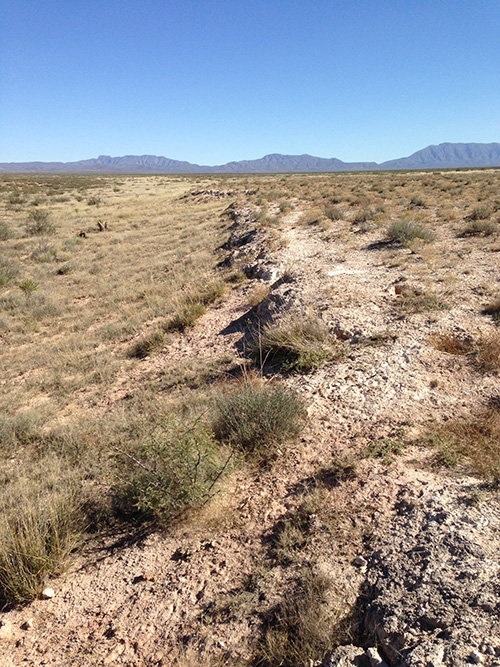
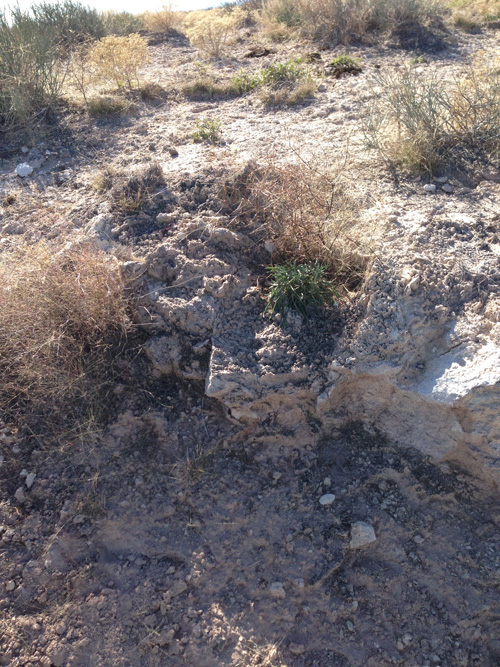
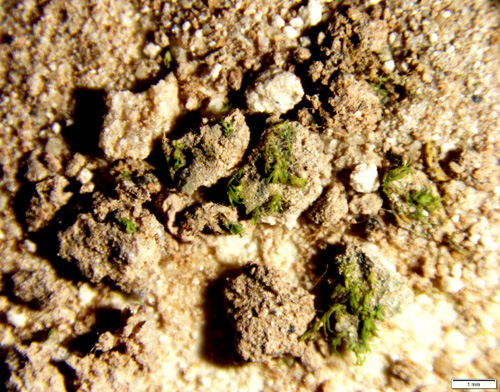
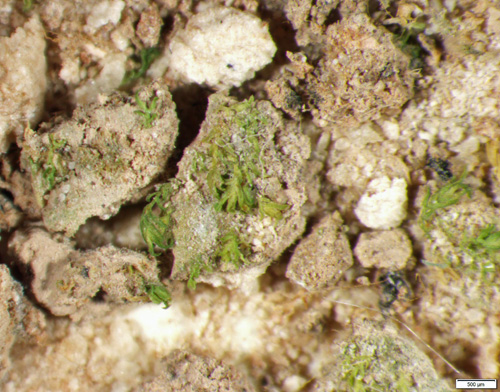
Vertical and circular walls of shaded gypsum sink holes and bluffs, 1300 m (4350 ft).
Conservation Considerations
The gypsum bluffs and sink holes are easily eroded by hard rainfall. The area is also frequented by domestic livestock, as there is a watering tank nearby. Their scrambling into and out of the depressions readily crumbles and corrodes the banks and walls.
References
Allred, K.W. 1998. Second collection of a little moss, Fissidens littlei (Williams) Grout, rediscovered from a little sinkhole in New Mexico. Evansia 15(4): 148-149.
Little, E.L. Jr. 1937. Bryophytes of the Jornada Experimental Range, New Mexico. The Bryologist 40: 81-83.
*Purcell, R.A. 2007. Fissidens, pp. 331-357. IN: Flora of North America, vol. 27. Oxford Univ. Press.
*Williams, R.S. 1936. Moenkemeyera littlei sp. nov. The Bryologist 39: 40-41.