


Cirsium gilense (Gilia Thistle)
NONE
| USFWS | State of NM | USFS | BLM | Navajo Nation | State Rank | Global Rank | NMRPTC Status |
|---|---|---|---|---|---|---|---|
| SEN | S2 | G3G5Q | R |
| Overall Conservation Status | Documented Threats | Actions Needed |
|---|---|---|
| EFFECTIVELY CONSERVED | No Information |
genetic studies |
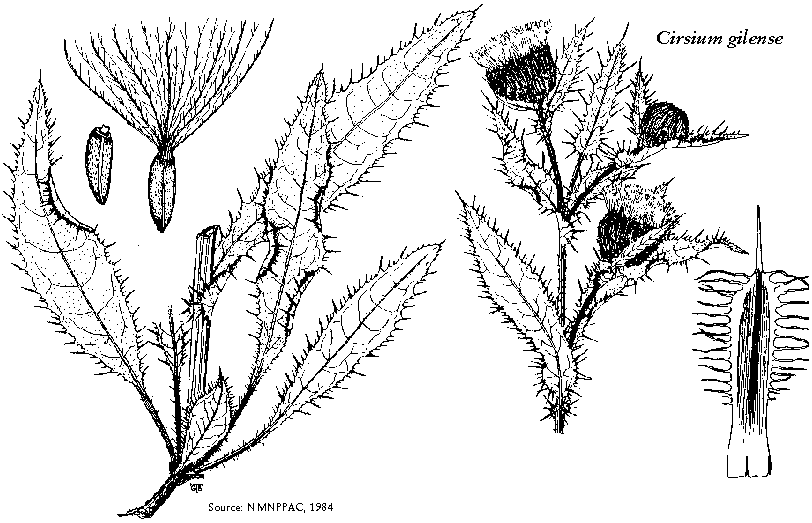
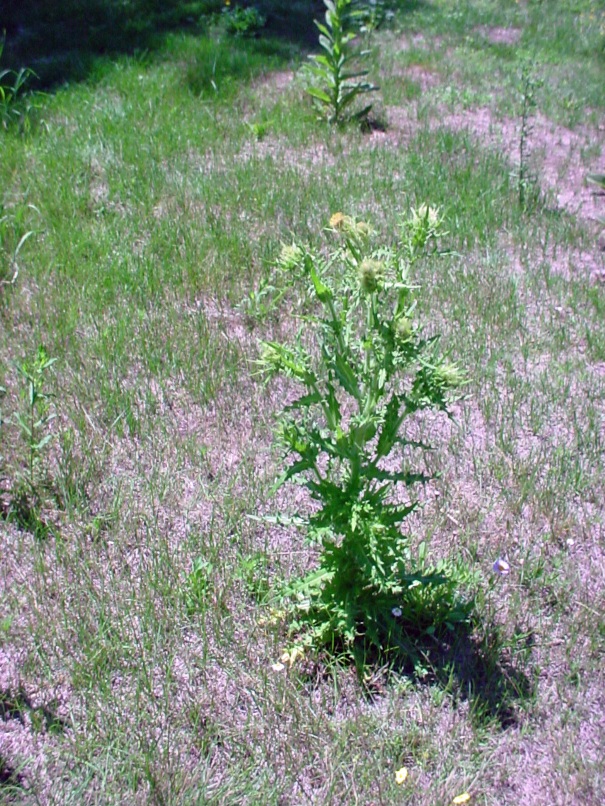
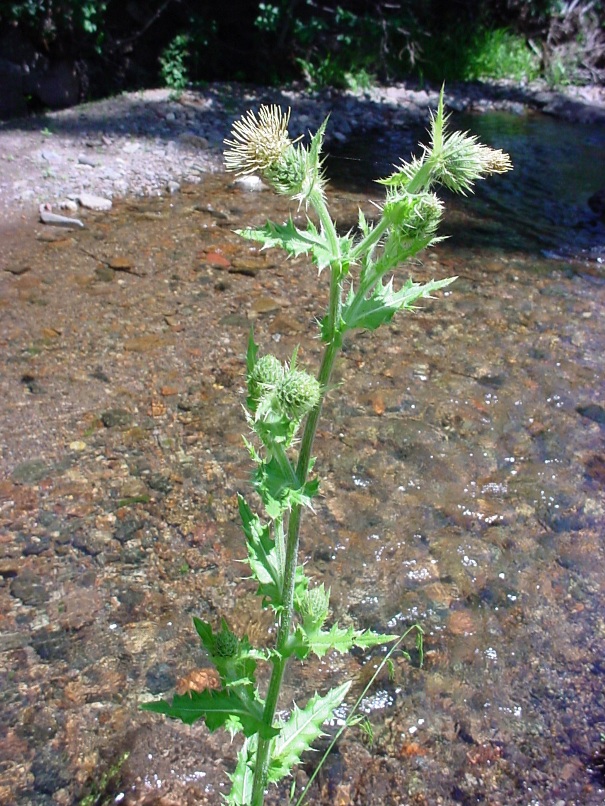
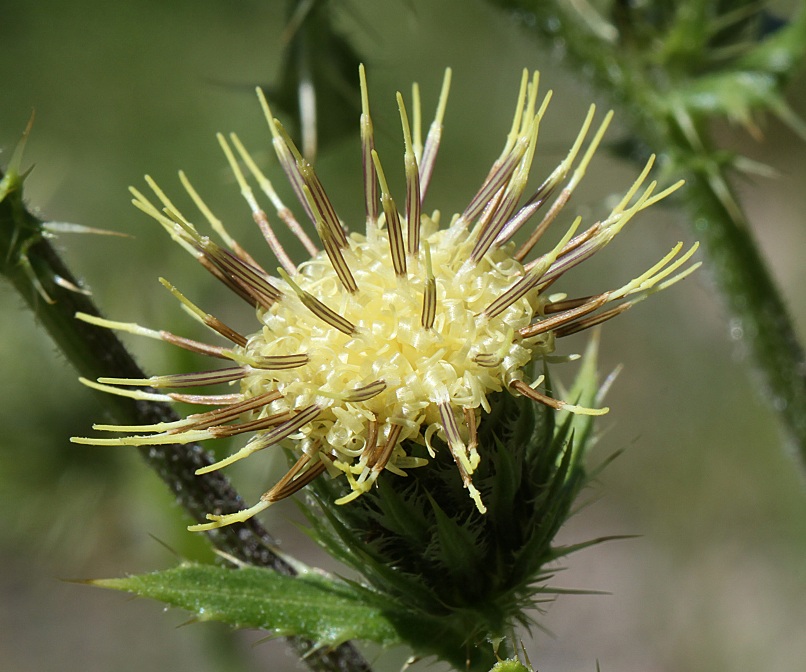
Biennial; stems up to 2 m tall, sparingly branched, hairy; leaves about 40 cm long, pointed at the tip, lobed, the lobes toothed, teeth tipped with slender spines, upper surface of the leaves hairy, lower surface without hairs; the base of the stem leaves partly surrounding the stem; flower heads greenish-yellow usually solitary at the ends of the branches, about 3 cm broad, and nearly as high; outer bracts of the flower head with cobwebby hairs and numerous small, spiny teeth of even length along the margins, much like that of a comb. Flowers July to September.
Cirsium gilense can be differentiated from any other yellow-flowered thistles in New Mexico by flowering heads that are at least 3 cm high and are solitary at the ends of branches. The bracts of the heads have broad green tips.
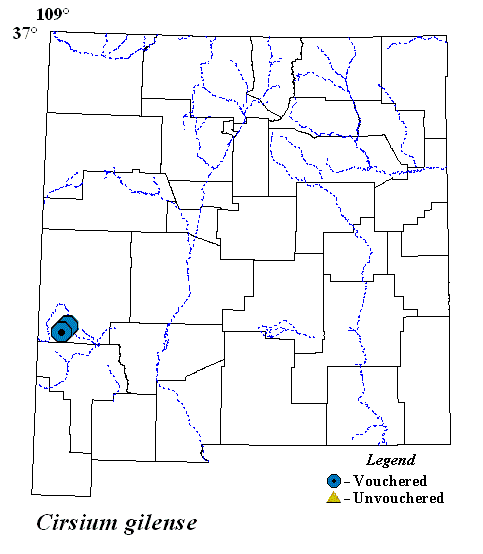
New Mexico, Catron County; adjacent Arizona, White Mountains.
Moist areas or mountain meadows in montane coniferous forest; 2,135-2,440 m (7,000-8,000 ft).
This taxon, along with all other yellow-flowered thistles of the Southwest, needs further study to clarify species boundaries.
All native thistles could potentially be impacted by exotic biological control agents imported to combat noxious exotic thistles.
*New Mexico Native Plants Protection Advisory Committee. 1984. A handbook of rare and endemic plants of New Mexico. University of New Mexico Press, Albuquerque.
Wooton, E.O. and P.C. Standley. 1913. Descriptions of new plants preliminary to a report upon the flora of New Mexico. Contributions from the U.S. National Herbarium 16:109-196.
For distribution maps and more information, visit Natural Heritage New Mexico